
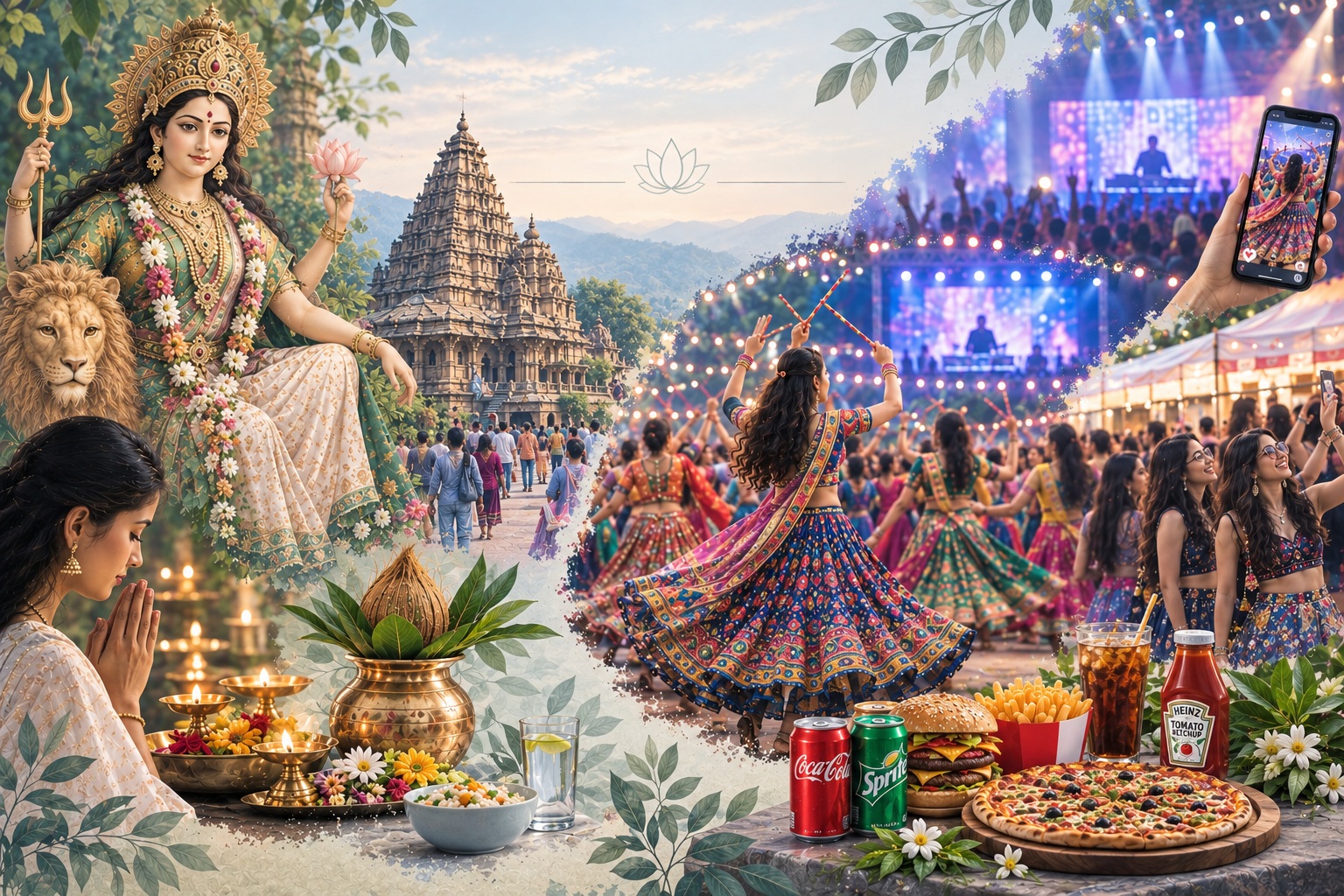
Navratri celebrations today often look very different from the observances of the past. Pilgrimage sites have become places for selfies and reels, and temples are seen as tourist attractions. Garba events can seem as much about food, fashion, and partying and less so about Devi worship. Tourism and economic activity are not necessarily problems; they support local businesses and help keep some traditions alive. But has the religious purpose of the festival taken a back seat?
Navratri has indeed changed over time, as Indic traditions do. Still, when deracination and disconnect take center stage, it is worth asking whether the connection to Devi, fasting, and inner transformation remains central to the festival.
Historical Meanings
Navratri, the nine nights dedicated to Shakti, represents the feminine life force within existence. In Sanatan philosophy, Devi embodies the power that sustains creation and enables transformation. Three days dedicated to each – Durga, Lakshmi, and Saraswati represent tamas (inertia), rajas (action and maintenance), and sattva (knowledge and purity)-qualities present in both Nature and human beings.
Navratri signifies inner transformation in this order: Durga symbolizes overcoming negative tendencies, Lakshmi signifies prosperity, and Saraswati symbolizes knowledge and wisdom. Through tyaga, or renunciation, one works to overcome ego and attachment and cultivate sattva, moving closer to transcendence. The tenth day, Vijayadashami, marks victory over personal limitations.
Contemporary trends raise a question for Indic society: are we still observing Navratri in the spirit of Devi worship, or has the festival become something different? Today, the focus of the nine-day festival seems to be on the spectacle of celebration rather than the religious experience itself. Transcendence is not necessarily on anyone’s mind.
From Sacred Observance to Entertainment
Historical and Religious Significance
Historically, Navratri was associated with Devi worship, rituals, and a collective understanding of the relationship between divine power and social order. Public ceremonies and elaborate displays and dances existed, but they operated within religious frameworks that had sanctity and meaning. In ancient and medieval India, the worship of Durga was also connected to kingship, political authority, and the protection of kingdoms; rulers supported temples, sponsored religious rituals, and invoked the Goddess’s power in the context of warfare and political legitimacy (Sarkar, 2017). Historically, religious institutions received patronage and material support, as evidenced in India and Nepal.
Garba, Entertainment, and Party Culture
The festival has evolved, and not all aspects have kept the religious elements intact. For example, what used to happen in every neighborhood locale has turned into something grandiose, with hundreds participating. A newspaper a few years ago came up with different colors for the nine days as a marketing hack, so that women would feel compelled to buy new ghaghras year after year – a trend that has stayed. Long gone are the days when moms used to fold up their saris to dress their little daughters, conduct practice Garba sessions each evening at a neighbor’s house with a large front porch. Perfection of dance steps was viewed as an offering to the Divine.
Garba, a folk dance associated with the worship of the Goddess, has undergone significant changes in its performance and cultural meaning. Chavda (2019) examines how commercialization, Bollywood influences, and changing social identities have contributed to these changes. Today, many celebrations emphasize ticketed Garba and Dandiya events, celebrity performers who set traditional Garba ‘songs’ to Bollywood beats, questionable, often obscene fashion, corporate sponsorships, and social-media visibility. The Aarti and joy of offering Prasadam have taken a back seat. Bollywood remixes take over traditional devotional Garba ‘songs,’ designer outfits and daily fashion themes encourage compulsive shopping, and Instagram reels turn Garba into a performative spectacle, with competition and prizes getting bigger each year.
These days, in many towns, Garbas are known for hookup culture and generate big business for gynecologists around town. People are making reels about flaunting their bikini tops masquerading as blouses, and just like the overall regression in India, the sacred is slowly transforming into the profane. In some places, the festival also revolves around nightlife, dating, and after-parties. Since Indian society is still culturally conservative in many aspects, little talk exists of how garba events are normalizing pre-marital sex. Garba season has increasingly acquired a reputation as a prime time for casual hookups, attracting even men from outside the Hindu community who view these events as opportunities for romantic and sexual encounters.
Food & Fasting
Decades ago, fasting was an integral part of Navratri for many families, and eating out was not central to the celebration. Today, pizzas, burgers, cheese, and mayonnaise feature prominently at all-night festival food stalls. The changes extend beyond food. Navratri has always evolved, and its regional traditions have never been uniform. However, the growing emphasis on consumption and indulgence raises questions about the place of fasting, restraint, and spiritual discipline in contemporary celebrations. Navratri has always evolved, and its regional traditions have never been uniform. However, the festival has turned into a normalization of the behaviors of bhogis and rogis.
Fasting once emphasized discipline, but today, indulgence increasingly overshadows it, weakening the spiritual observance at the heart of the festival. Navratri is changing, and the changes are visible in how people celebrate it today. Garba nights now feature club-type DJs, elaborate designer fashion, food stalls, and endless social-media reels. There is nothing wrong with enjoying the festivities or spending money on them. But when the party becomes disconnected from the roots, i.e., more important than the worship of Devi, it is worth asking what has been lost along the way. When Devi worship, fasting, and spiritual discipline become secondary to fashion, entertainment, and consumption, does the festival risk becoming deracinated from the Indic worldview that gave it meaning?
Navratri is about more than celebrating Devi; it is also about understanding what she represents and what is being preserved by Indic society. Many of the trends discussed above have little to do with the festival’s original purpose.
References
Chavda, M. (2019). Performing Garba (the clap dance): Choreographic and commercial changes. Dance Chronicle, 42(1), 78–101. https://doi.org/10.1080/01472526.2018.1563468
Sarkar, B. (2017). Heroic Śāktism: The cult of Durga in ancient Indian kingship. Oxford University Press. https://doi.org/10.5871/bacad/9780197266106.001.0001