
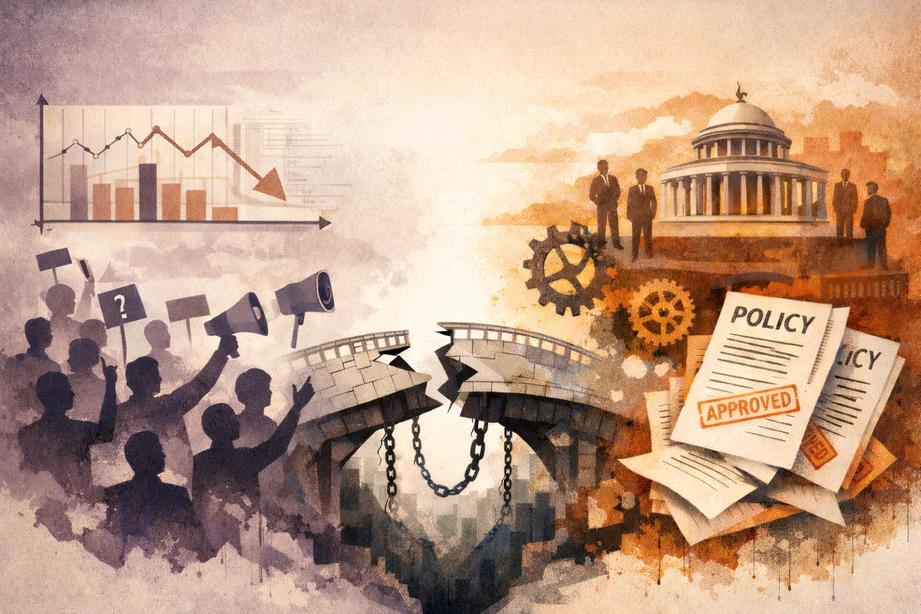
Democratic theory presumes a meaningful relationship between public opinion and public policy, whereby citizen preferences are aggregated through institutions and reflected in governance outcomes (Dahl, 1971; Easton, 1965). However, in India, a substantial body of political science and political economy literature demonstrates that this relationship is weak and inconsistent (Kohli, 2004; Chhibber & Verma, 2018; Varshney, 2010). Policy outcomes are frequently shaped by elite bargaining, bureaucratic autonomy, and identity-based political mobilization rather than by aggregated public preferences (Chandra, 2004; Besley & Burgess, 2002; Stokes, Dunning, Nazareno, & Brusco, 2013). The recent controversies surrounding University Grants Commission (UGC) policies in higher education provide a contemporary example/case study of such a structural disconnect between public opinion and policy-making (CSDS–Lokniti, various years; Afridi, 2017).
Literature Review
Scholars have long noted that Indian democracy exhibits high electoral participation but low policy responsiveness. Kohli (2004) characterizes the Indian state as an elite-driven democracy in which bureaucratic and political institutions enjoy significant autonomy from mass opinion, particularly in policy domains that require technical expertise. While elections are competitive, policy-making often occurs in isolation from public preference. And this is how the Indian case differs from the West.
Chandra (2004) explains this insulation through the dominance of identity-based mobilization. In contexts where political competition revolves around caste, ethnicity, and patronage, voters are less likely to reward or punish governments for specific policy choices (they might forget, or they are forgiving). This behavior weakens the feedback loop between public opinion and public policy, especially in sectors such as education.
Party behavior further limits responsiveness. Chhibber and Verma (2018) argue that Indian political parties lack stable ideological commitments, resulting in opportunistic policy-making, rather than systematic representation of voter preferences. Thus, policy choices are often driven by coalition constraints, judicial oversight, and bureaucratic consensus, reducing the influence of public opinion even when preferences are broadly shared (2018). (This phenomenon and its reasons will probably be discussed in another blog piece in depth.)
Varshney (2010) conceptualizes this phenomenon as a distinction between electoral accountability and policy accountability. Governments remain sensitive to election outcomes but face few penalties for pursuing unpopular or unresponsive policies between electoral cycles. Survey evidence from the CSDS–Lokniti program consistently shows public concern over education quality, employment outcomes, and merit-based access, yet these preferences rarely translate into substantive policy reform (CSDS–Lokniti, multiple years).
Econometric studies reinforce these observations. Besley and Burgess (2002) use panel data across Indian states to show that government responsiveness is strongly conditioned by electoral accountability and information environments (e.g., newspaper circulation), rather than by public demand alone. Afridi (2017) and Mallick, Padhi, and Mishra (2023) demonstrate that institutional capacity, governance quality, and social context systematically shape whether citizen preferences are realized in outcomes. Together, these studies suggest that public opinion alone is insufficient to influence policy; it must be activated and mediated through effective institutions. This is the weakness of the Indian state; there was no freedom at midnight, so to speak. Though India technically became free in 1947, the institutional machinery, ideology, and practices remain largely the same, regardless of the party in power.
The UGC Policy Fiasco
The 2026 UGC regulations established mandatory Equal Opportunity Centres, equity committees, and enforceable anti‑discrimination rules across universities. They have sparked protests and criticism for being ambiguous, burdensome, and ill-suited to India’s diverse higher education landscape (Mukherjee, 2026). Minister(s) and bureaucrats on the committees appear to have either overlooked or mismanaged the proposal.
Additionally, concerns regarding declining academic standards, shrinking unreserved opportunities, and weak employability outcomes are widely expressed by students, parents, and middle-class households. Yet these concerns have had minimal influence on the UGC ministers – past and present – and the Educational bureaucracy in general, which has had issues perceiving actual problems and suggesting warranted solutions.
Instead, UGC reforms have emerged mainly from bureaucratic cooption (also path dependence) and elite policy consensus, with minimal or no public consultation, aligning closely with Kohli’s (2004) depiction of a bureaucratically insulated policy-making process. The econometric evidence from Besley and Burgess (2002) also shows that the responsiveness of the state/bureaucrats is contingent on enabling institutional conditions rather than on the mere existence of public opinion and preferences. That is, public opinion has little effect on actual policy-making.
Even as General category students and families take to the streets to protest UGC policies, including aspects of the SC/ST reservation framework that they view as limiting their opportunities, these demonstrations might not produce meaningful or desired policy change. As Chandra (2004) states, entrenched identity-based political structures and elite-driven decision-making dilute the impact of issue-focused activism. As a result, long-term dissatisfaction among General category students and families, despite being numerically significant and their arguments constitutionally sound, might continue to fail to translate into policy recalibration.
The UGC example further reflects Chhibber and Verma’s (2018) argument that Indian policy-making is shaped more by political risk management than by public demand. Bureaucracies and policy-makers will craft what they think fits. Thus, reforms perceived as electorally sensitive, particularly those related to reservations and admissions, are avoided even when evidence suggests long-term costs to institutional quality and effects on social cohesion. Policy inertia has thus become the norm, with the state, the bureaucracy, and the judiciary, for the most part, spectators.
Implications
In India, public opinion and voter preferences clearly influence electoral outcomes, with leadership appeal, party policy, and campaign messaging shaping voter behavior in both state and national elections (Chatterjee & Dutta, 2024; Sharma & Kanojia, 2022). Yet, the UGC controversy highlights a democratic paradox: despite widespread protests and criticism of the new equity regulations, public opinion has had little impact on actual policy decisions, with no immediate rollback or redesign by policy-makers (Times of India, 2026). Higher education policies, which play a critical role in access, social mobility, and furthering economic growth, are largely shaped by elite negotiations and crystallized bureaucratic routines, rather than by what citizens prefer. In practice, the party in power often makes little difference; the bureaucracy continues to operate much the same way, regardless of political ideology.
This could be seen as a failure resulting in a form of democracy in which procedural participation outpaces the government’s responsiveness. That is, the bidirectionality of public opinion and policy-making remains a one-way street. Econometric findings reinforce that public preferences are unlikely to affect policy unless institutional channels and civic information networks are robust or belong to perceived protected minorities. Until these mechanisms are strengthened, and a thorough cleansing (decolonization?) of institutions occurs, fiascos like the UGC episode are likely to persist.
References
Afridi, F. (2017). Governance and public service delivery in India (IGC synthesis paper). International Growth Centre. https://www.theigc.org/sites/default/files/2017/05/Afridi-2017-Synthesis-paper.pdf
Besley, T., & Burgess, R. (2002). The political economy of government responsiveness: Theory and evidence from India. The Quarterly Journal of Economics, 117(4), 1415–1451. https://eprints.lse.ac.uk/2308/1/The_Political_Economy_of_Government_Responsiveness_Theory_and_Evidence_from_India.pdf
Chandra, K. (2004). Why ethnic parties succeed: Patronage and ethnic head counts in India. Cambridge University Press.
Chatterjee, J., & Dutta, G. (2024). A systematic literature review to understand the difference between critical factors affecting the national election and state elections in India. Frontiers in Political Science. https://doi.org/10.3389/fpos.2024.1323186
Chhibber, P., & Verma, R. (2018). Ideology and identity: The changing party systems of India. Oxford University Press.
CSDS–Lokniti. (Various years). National election studies and social attitudes surveys. Centre for the Study of Developing Societies.
Kohli, A. (2004). State-directed development: Political power and industrialization in the global periphery. Cambridge University Press.
Mallick, H., Padhi, B., & Mishra, U. S. (2023). An assessment of public confidence in governance institutions in India: Empirical evidence using IHDS survey. Journal of Governance and Economics, 100080. https://www.sciencedirect.com/science/article/pii/S266731932300023X
Mukherjee, R. (2026, January 28). UGC equity regulations: Why protests have erupted across campuses. India Today. https://www.indiatoday.in/education-today/featurephilia/story/are-ugcs-new-anti-discrimination-rules-really-about-caste-alone-2859108-2026-01-28
Sharma, S., & Kanojia, A. (2022). The “New Welfarism,” Good Governance, and Electoral Success in Modi’s India. The Journal of Indian and Asian Studies, 3(2). https://doi.org/10.1142/S2717541322400010
Stokes, S. C., Dunning, T., Nazareno, M., & Brusco, V. (2013). Brokers, voters, and clientelism: The puzzle of distributive politics. Cambridge University Press.
Times of India. (2026, January 29). Supreme Court stays UGC equity regulations 2026: A timeline of protests, politics, and the court’s intervention. Times of India. https://timesofindia.indiatimes.com/education/news/supreme-court-stays-ugc-equity-regulations-2026-a-timeline-of-protests-politics-and-the-courts-intervention/articleshow/127775787.cms?utm_source=chatgpt.com
Varshney, A. (2010). Ethnicity and ethnic conflict. Oxford University Press.