
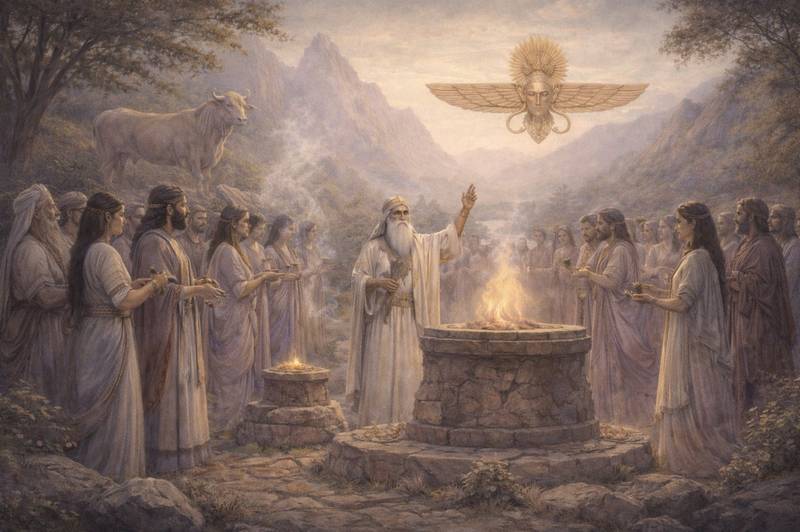
Iran stands at a historical crossroads. For decades, Iranians have protested against the authority of the Ayatollahs, demanding greater political freedom, decent women’s rights, and an end to Islamic rules and imposition, often receiving violent crackdowns from the government. Beneath this history lies an older foundation, one that predates Islam and deeply connects Iran to the wider Indo-Aryan world, including ancient India. In other words, the roots of Iranian civilization are pagan, indigenous, and remarkably similar to early Indian spiritual traditions (Oberlies, 2023). The question at this moment in time is whether Iran will return to its original existence or continue to function as an Islamic republic.
Context
Iran’s modern history reflects a dramatic shift in governance and societal structure. Before 1979, under the Pahlavi monarchy, Iran was a centralized secular state led by Mohammad Reza Shah, who pursued modernization, economic development, and Western alignment while limiting clerical influence (Abrahamian, 1982; Katouzian, 2003; Axworthy, 2013). Land reforms, literacy campaigns, and women’s suffrage marked attempts at social progress, though they fueled tensions with traditional and religious sectors of society (Katouzian, 2003). Following the 1979 Islamic Revolution, the monarchy was replaced by an Islamic Republic, where the Supreme Leader and institutions like the Revolutionary Guard centralized power under Shia clerical authority, enforcing religious law and suppressing political dissent, while provoking domestic opposition and international tensions (Kamrava, 2023; Islamic Rights or Human Rights, 2022). This historical arc sets the stage for contemporary debates over cultural identity, including Iran’s potential reconnection with its pre-Islamic, indigenous, and Indo-Iranian spiritual roots (Oberlies, 2023; Malandra, n.d.; Iranica Online, n.d.).
The ancient Iranians shared a common cultural heritage with the early Vedic peoples of India. Before Zoroaster codified Persian spirituality, Indo-Iranian communities worshiped natural forces, celebrated cosmic order, and practiced fire rituals – all central elements of Vedic India (Malandra, n.d.; Iranica Online, n.d.). Concepts like duality of existence, moral responsibility, and reverence for natural phenomena were already embedded in daily life. Linguistic and ritual parallels, such as ahura in Avestan and asura in Sanskrit, as well as the ritual use of haoma/soma, indicate a shared Indo-Iranian religious milieu that predates the emergence of Zoroastrianism and Vedic codification (Indian Embassy Tehran, n.d.; Oberlies, 2023).
Iran does not fit the typical Liberal Narrative
Iran’s plight, especially the visible oppression of women, received mixed reactions from traditional Western liberal feminists. Critics argue that many Western feminist and liberal activists have been hesitant to condemn human rights abuses in Iran because criticizing government policies tied to religion, such as compulsory veiling, could be misinterpreted as criticism of Islam itself. Thus, the feminists conveniently looked the other way when Iranian women were punished, publicly tortured, and even eliminated by the regime.
Given the global phenomena of the left’s congruence with Islam, it was best for feminists to be silent on this issue. Similarly, for ‘newer’ Islamic converts, it was convenient to ignore the brutal treatment of women and the overall dislike for the ruthless Islamic regime in general. In fact, converts from the Indian subcontinent mourned the leader’s death in a manner akin to devotional veneration. Research shows that the fear of fueling Islamophobic or neo‑orientalist narratives made many leftist activists cautious, worrying that critique could be co-opted by anti-Muslim rhetoric or framed as cultural imperialism rather than legitimate human rights advocacy (Gashtili, 2024; Association for Iranian Studies, n.d.). As a result, global feminist discourse has at times been muted, sidelining the voices and experiences of Iranian women fighting for autonomy (Gashtili, 2024).
Where to from Here?
Now, as modern Iranians witness the weakening of religious authoritarianism, there exists a unique opportunity: a chance to reconnect with their pre-Islamic, indigenous practices. This would not be mere yearning for nostalgia; it would be cultural and spiritual reclamation! Pre-Zoroastrian Iranian religion was a nature-based polytheism that worshipped deities and the Sun, Earth, and Fire. Re-engaging with ancient rituals, celebrating solstices, honoring the natural elements, and embracing the moral and philosophical frameworks shared with India’s Vedic traditions could provide Iranians a sense of identity unmediated by centuries of religious hierarchy (Malandra, n.d.; Iranica Online, n.d.).
Such a revival would also bring forth the shared heritage of the Indo-Iranian world, highlighting the religious, philosophical, and cultural connections, trade, and other interactions between Iran and India. From fire rituals to ethical dualism, the core principles of these ancient cultures emphasize harmony with the cosmos and moral accountability – values that resonate today as much as they did millennia ago (Oberlies, 2023).
Iran is experiencing political uncertainty, as cultural hardships and leadership transitions (upheavels) challenge the clerical regime’s authority, raising questions about the country’s stability following the Ayatollah’s death. In reclaiming their indigenous roots, Iranians have the potential not only to revive cultural practices suppressed for centuries but also to reshape a national identity grounded in original ancient wisdom, humanistic ethics, and a spiritual connection to the natural world (Indian Embassy Tehran, n.d.).
References
Abrahamian, E. (1982). Iran between two revolutions. Princeton University Press.
Association for Iranian Studies. (n.d.). Feminisms, Islamic and secular. https://associationforiranianstudies.org/content/feminisms-islamic-and-secular
Axworthy, M. (2013). A history of Iran: Empire of the mind. Basic Books.
Gashtili, P. (2024). Iranian Women’s Uprising: Lessons for Euro‑American Academic Feminism. Global Studies Quarterly. Cambridge University Press. https://academic.oup.com/isagsq/article-abstract/5/3/ksaf063/8240739
Kamrava, M. (Ed.). (2023). The Islamic Republic of Iran in historical and institutional perspective: Ruptures and continuities. In The Sacred Republic: Power and Institutions in Iran. Oxford University Press.
Katouzian, H. (2003). State and society in Iran: The eclipse of the monarchy. I.B. Tauris.
Islamic Rights or Human Rights: An Iranian Dilemma. (2022). Iranian Studies. Cambridge University Press. https://academic.oup.com/book/56007/chapter/440499520?utm_source=chatgpt.com
Indian Embassy Tehran. (n.d.). Vedic and Persian religions (both Aryan). Embassy of India, Tehran. https://www.indianembassytehran.gov.in/index.php/eoithr_pages/MTc?utm_source=chatgpt.com
Iranica Online. (n.d.). Indo-Iranian religion. Encyclopaedia Iranica. https://www.iranicaonline.org/articles/indo-iranian-religion/?utm_source=chatgpt.com
Malandra, W. W. (n.d.). Ancient Iranian religion (pre-Zoroastrian). Encyclopædia Britannica. https://www.britannica.com/topic/ancient-Iranian-religion/Origin-and-historical-development?utm_source=chatgpt.com
Oberlies, T. (2023). The Indo-Iranian religion. In The Religion of the Ṛgveda (pp. 47–71). Oxford University Press. https://academic.oup.com/book/55908/chapter/439307392?utm_source=chatgpt.com