
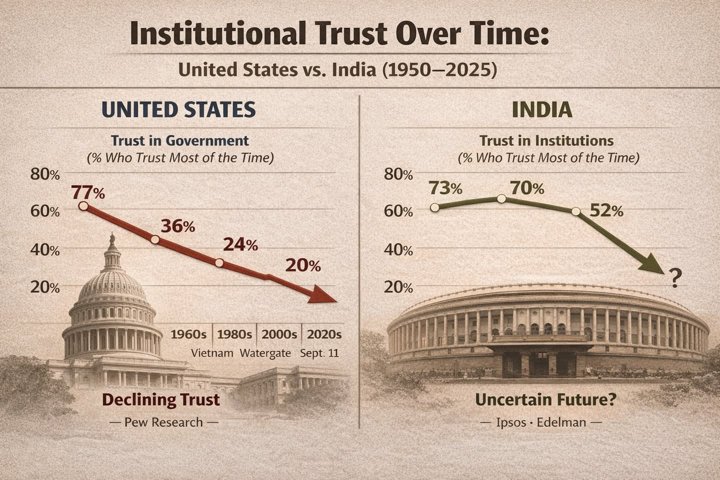
Trust in government and public institutions is a core indicator of democratic legitimacy and political stability (Easton, 1965; Norris, 2011). Political scientists have long measured institutional trust to understand citizens’ perceptions of governance, accountability, and democratic performance (Dalton, 2004; Levi & Stoker, 2000). A comparison between the United States and India reveals differences in long-term trends. While trust in government has declined significantly in the United States since the mid-twentieth century, survey data suggest that institutional trust in India has remained comparatively higher in recent decades (Dalton, 2004; Inglehart et al., 2020). However, what will the data look like for India with fast-rising discontent with the executive and the judiciary, and also, what will trust in the U.S. look like, given that most Americans find going to war contentious (Gelpi, Feaver, & Reifler, 2009; Pew Research Center, 2023)?
In the United States, trust in government has been systematically measured for decades through surveys such as the American National Election Studies (ANES) and longitudinal polling analyzed by the Pew Research Center (American National Election Studies, 2022; Pew Research Center, 2025). These surveys commonly ask whether respondents trust the federal government in Washington to “do what is right” most or all of the time (American National Election Studies, 2022). Historical data show that trust was extremely high in the early postwar era. Approximately 73% of Americans expressed trust in the federal government in 1958, and the figure reached roughly 77% in 1964 (Pew Research Center, 2025). However, trust declined sharply during the late 1960s and 1970s, influenced by events such as the Vietnam War and the Watergate scandal (Dalton, 2004; Hetherington, 2005). By 1974, public trust had fallen to roughly 36% (Pew Research Center, 2025). Although trust fluctuated in subsequent decades, including a temporary increase after the September 11 attacks, when trust rose to about 54%, the overall trajectory has been downward (Chanley, Rudolph, & Rahn, 2000; Pew Research Center, 2025). In recent years, surveys indicate that only around 17–22% of Americans report trusting the federal government most of the time (Pew Research Center, 2025).
India presents a different empirical pattern, though measurement is less continuous. Unlike the United States, India does not have a single long-running national survey comparable to the American National Election Studies, though Lokniti comes close (Yadav & Palshikar, 2009). Institutional trust is captured through several international and national surveys, including the World Values Survey, the Edelman Trust Barometer, and election studies conducted by the Centre for the Study of Developing Societies (the Lokniti program) (Inglehart et al., 2020; Kumar & Gupta, 2016). These datasets consistently show relatively high levels of institutional confidence. For example, survey waves from the World Values Survey have reported that approximately 60% of Indian respondents express confidence in government institutions (Inglehart et al., 2020). Similarly, the Edelman Trust Barometer has frequently recorded overall institutional trust levels around 70–75% in India during the 2010s and early 2020s (Edelman, 2025). Additional cross-national surveys indicate that roughly 52% of Indians report trusting government institutions, still higher than comparable figures in many advanced democracies (Ipsos, 2023).
Several structural explanations have been proposed to account for these differences. Scholars often note that advanced democracies such as the United States have experienced declining trust due to political polarization, institutional gridlock, and heightened public scrutiny of government performance (Dalton, 2004; Hetherington, 2005; Norris, 2011). By contrast, developing democracies such as India may exhibit relatively higher institutional trust due to strong identification with national leadership, lower historical expectations of state capacity, and the continuing legitimacy derived from economic development and democratic consolidation (Inglehart et al., 2020; Yadav & Palshikar, 2009). Comparative research using datasets such as the World Values Survey suggests that these patterns are not unique to India but are broadly observed across several emerging democracies (Inglehart et al., 2020).
While the data for the U.S. on trust in government and institutions show a decline, a similar beginning of a decline could be predicted for India as well, given that two out of three branches have emerged as making non-democratic decisions. The judiciary in India has been plagued with backlog and nepotism, and even corruption, coupled with legislating from the bench (Krishnan, 2010; Nick Robinson, 2013). The laws in question are leading to upper-caste hatred and artificial divisions in society, where narratives against the upper caste are now translating into real-life rapes and murders. The executive branch continues to seek votes while continuing to craft divisive policies, slowly isolating a core voter base (Chhibber & Verma, 2018; Vaishnav, 2017). The media and public agenda are actively displaying democratic discontent, but this seems to be falling on deaf ears.
In recent years, public trust in the Indian government has been eroded by high-profile controversies, including the SC–ST Act enforcement debates, the UGC fiascos, and persistent judicial backlogs that delay justice. At the same time, the judiciary is taking undemocratic actions to maintain a pristine image. These issues are fueling growing distrust about the government’s ability to uphold democratic norms. Overall, the comparison highlights a key divergence in democratic attitudes. The United States demonstrates a long-term decline in institutional trust from mid-twentieth-century highs to historically low levels today. India, while lacking a continuous time series, has exhibited relatively higher levels of public confidence in government institutions across multiple surveys, until now. These contrasting trajectories may not be so contrasting from here on.
References
American National Election Studies. (2022). ANES cumulative data file (1948–2020). University of Michigan & Stanford University.
Chanley, V. A., Rudolph, T. J., & Rahn, W. M. (2000). The origins and consequences of public trust in government. Public Opinion Quarterly, 64(3), 239–256.
Chhibber, P., & Verma, R. (2018). Ideology and identity: The changing party systems of India. Oxford University Press.
Dalton, R. J. (2004). Democratic challenges, democratic choices: The erosion of political support in advanced industrial democracies. Oxford University Press.
Easton, D. (1965). A systems analysis of political life. Wiley.
Edelman. (2025). Edelman Trust Barometer global report 2025.
Gelpi, C., Feaver, P., & Reifler, J. (2009). Paying the human costs of war: American public opinion and casualties in military conflicts. Princeton University Press.
Hetherington, M. J. (2005). Why trust matters: Declining political trust and the demise of American liberalism. Princeton University Press.
Inglehart, R., Haerpfer, C., Moreno, A., Welzel, C., Kizilova, K., & Diez-Medrano, J. (2020). World Values Survey: Round seven country pooled datafile. World Values Survey Association.
Ipsos. (2023). Global trust in institutions survey.
Krishnan, J. K. (2010). Lawyering for a cause and experiences from abroad. Fordham Law Review, 78(5).
Levi, M., & Stoker, L. (2000). Political trust and trustworthiness. Annual Review of Political Science, 3, 475–507.
Nick Robinson. (2013). Structure matters: The impact of court structure on the Indian and U.S. Supreme Courts. American Journal of Comparative Law, 61(1), 173–208.
Norris, P. (2011). Democratic deficit: Critical citizens revisited. Cambridge University Press.
Pew Research Center. (2025). Public trust in government: 1958–2025.
Vaishnav, M. (2017). When crime pays: Money and muscle in Indian politics. Yale University Press.
Yadav, Y., & Palshikar, S. (2009). Between fortuna and virtu: Explaining the Congress’ ambiguous victory in 2009. Economic and Political Weekly, 44(39), 33–46.