
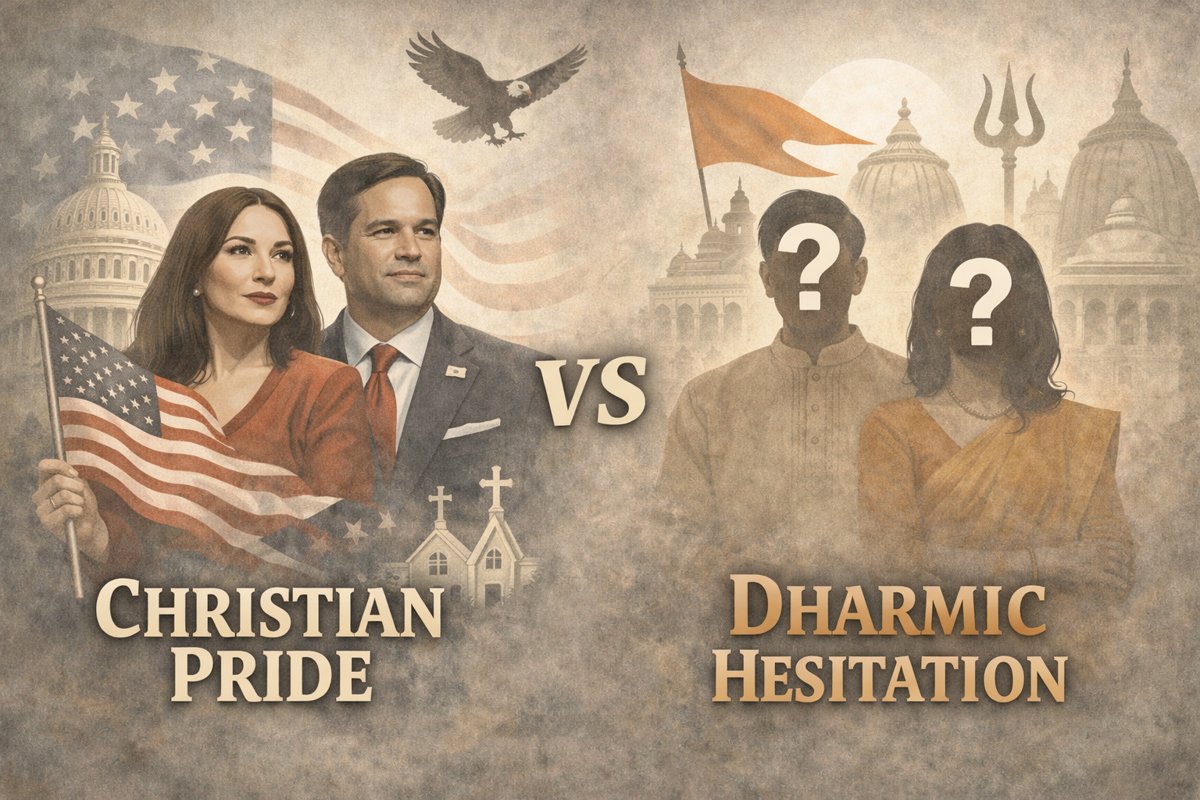
One of the most striking political moments in recent history was evident in Secretary Marco Rubio’s speech. It solidified the ethos of White Christian leadership in the West, particularly in Europe and America. Rubio’s address was unapologetically clear – he reinforced the ethnic and religious foundations of the combined landmass of Europe and North America. In doing so, he projected a confidence long absent from Western discourse after decades of post-World War II self-criticism, self-imposed guilt, and the influence of Frankfurt Marxism. Recently, however, some Western political discourse has shifted toward a bold celebration of Western civilization, with White Christians loudly reaffirming their identity and heritage. Even conservative female voices such as Laura Loomer are becoming known for being an unapologetic Islamophobe, showing bravery by speaking out against the influence of growing sharia in her nation. While being Jewish herself, she is proud of the original Christian ethos of the United States. Comparatively, while India is supposedly seen to be ruled by a conservative government, there is no such pride or resurgence showcasing civilizational pride.
Reassertion of Western-Christian Identity
Rubio’s message to a Europe in decline is a calculated act of masterful statecraft and reassurance for Western White Christians. His speech demonstrates patterns of Christian leadership – bold vision, confident authority, and the celebration of a civilization’s identity. Euro-American civilization stemmed from Greco-Roman-Pagan roots and then underwent Christian dominance. It was built through invasions, genocide, colonialism, land grabs, and slavery – realities which Rubio cleverly neither acknowledged nor disowned. By calling for tighter borders and Christian identity, he signaled a revival of assertive Western leadership, an “American Revolution 2.0.” The speech hoped to jump-start the removal of the political lethargy and identity crisis visible in the West. Rubio positioned himself as a viable successor to Donald Trump.
Similarly, Loomer’s controversial statements against H1B visas and ‘racist’ remarks against Indians have seen a nuance and a change of heart, as evident by her visit and Q&A in front of a predominantly secular, Indian audience. She stood fearless, exhibiting female power while putting dhimmi Indians in their place and pointing out their lack of understanding of sharia, the danger of electing people like New York Mayor Zohran Mamdani, and thereby their naivety in understanding survival and nationalism. Irrespective of her staunch support for President Trump, Loomer has the gumption to call him out on cozying up to the terrorist state of Pakistan and the Islamic nations in general. In short, Euro-America is discovering its own version of “Hindutva,” despite not claiming pagan roots.
India’s Leadership Vacuum
This write-up doesn’t intend to oversimplify complex political and cultural situations in the two nations. Still, the contrast with India is striking when it comes to the kind of firm leadership Rubio and Loomer advocate – leadership centered on Christian heritage, Western identity, immigration and borders, and cultural preservation. India, the world’s oldest continuous civilization, has unmatched cultural depth and spiritual continuity, yet its leaders rarely show the vision or conviction that Rubio demonstrates. Most leaders in power are afraid to call themselves Hindu or be associated with the perceived political movement of civilizational resurgence – Hindutva. Though India has a longstanding history of dharmic governance capable of managing its diverse population, Hindu policymakers seem hesitant and/or fearful to showcase these values. Leadership guided by dharma would require grounded leaders with a clear vision, who would express pride in the nation’s history and implement what has continued to work without apology. However, this is not the present case.
In sum, there are a few leaders in the U.S. full of conviction and vision, showcasing the idea of a Christian civilization, albeit shaped by selective memory. One doesn’t need to agree with their views, but one can admire the clarity and self-assurance. India, on the other hand, has centuries of philosophical, cultural, and governance success, and yet its leaders, irrespective of party, rarely show the courage or the clarity to project civilizational excellence. Thus, in India, Hindutva tends to remain a rhetoric reserved for speeches and news bites, but rarely translated into leadership or meaningful action. i.e., There are no Rubios, or Loomers, even in the supposed conservative camp. One might mention Yogi Adityanath, who has the vision but is associated with the wrong type of platform, and thereby still a product of colonial consciousness.
The contrast is clear: one side has confidence sans history, the other has history without confidence. True civilizational strength comes from having leaders who live their heritage fully and project it with clarity, stability, and vision. And so, one cannot help but lament: India awaits leaders of such courage, those bold enough to project its civilizational legacy with pride and conviction, aligned not just in ideology and dharmic leadership but also within a conducive organization/platform.