
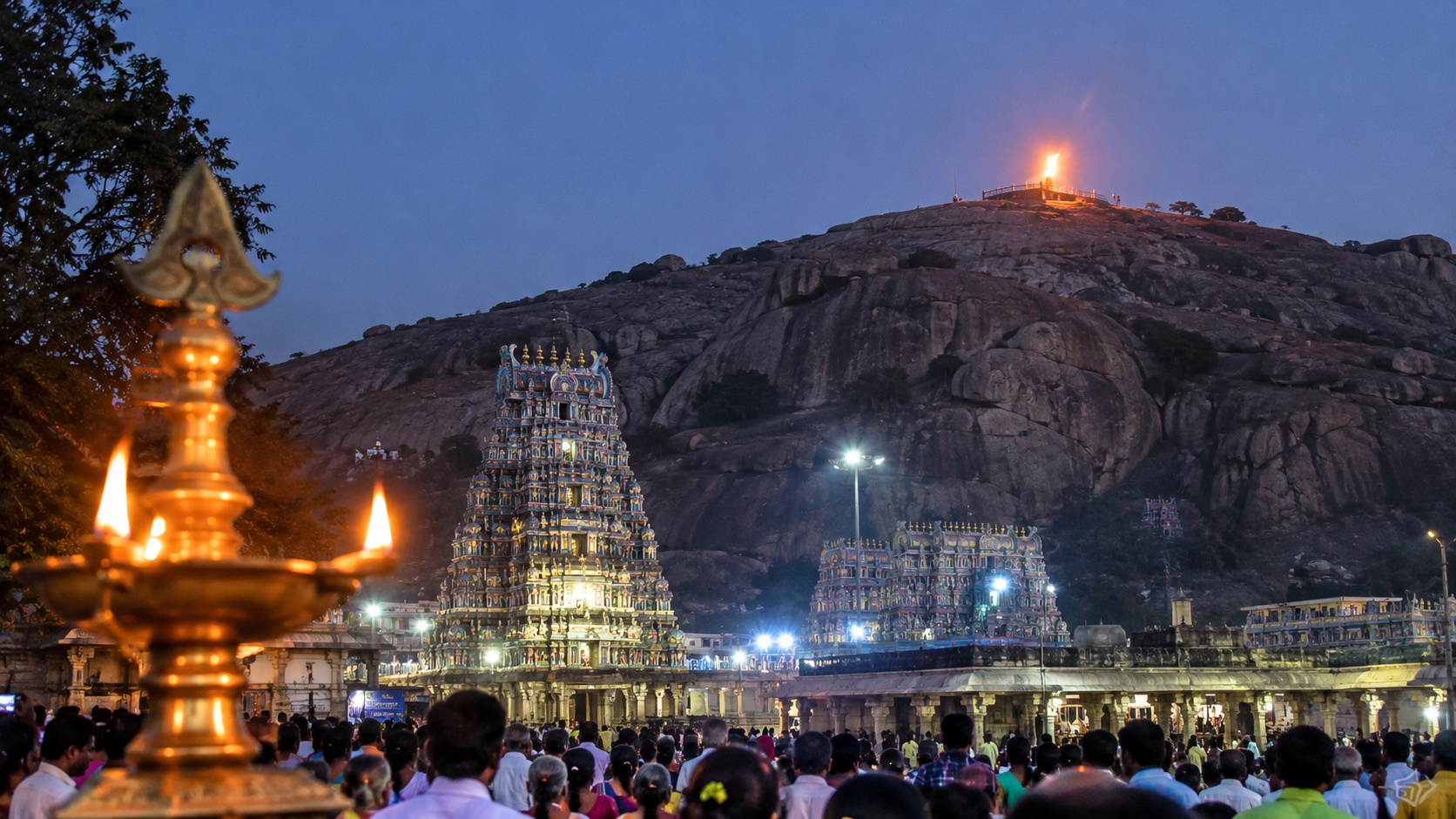
The lighting of Karthigai Deepam at Thiruparankundram is not merely a question of casual ritual. It has now become a question surrounding the ability of the Hindu devotee to exercise a religious practice without State and administrative obstruction, even when approved, though only on a one-time interim basis by the Supreme Court of India.
The Sacred History
The lighting of the Deepam is a centuries-old practice mentioned in various Hindu literary texts and poems. References to the festival appear in Sangam poetry (approximately 300 BCE–300 CE), including Akananuru and Natrinai, which describe the lighting of lamps during the Karthigai season. Natrinai (poem 202) evokes rows of lamps resembling flowers in bloom, reflecting the importance of the festival in early Tamil cultural and religious life. These references indicate that Karthigai lamp observances have been part of Tamil tradition for nearly two millennia, long before Christianity and Islam came along. The tradition is also reflected in later Tamil literature, including Kaar Narpathu (poem 26), which draws upon the imagery of lamps lit during Karthigai, and Civaka Cintamani (10th century), which contains imagery associated with lighting lamps on a hill, making it relevant to the hilltop Deepam tradition (Arumugam, 2024).
Thiruparankundram is one of the six sacred abodes (Arupadai Veedu) of Murugan, the son of Shiva, and holds significance in Tamil religious tradition. Its association with Murugan is documented in ancient Tamil devotional literature, including Tirumurukarruppatai, attributed to Nakkirar. According to temple tradition, the hill is associated with Murugan’s victory over Surapadman and his marriage to Deivayanai, the daughter of Indra. The site’s sacred significance is indeed rooted in Tamil literature, historical memory, and centuries of pilgrimage, rather than being a simple religious designation (Peres, 2024).
On November 24, 2026, the Indian Supreme Court permitted the lighting of the lamp at the Deepathoon as a one-time measure (Ananthakrishnan, 2026). Yet, on the day of the festival, the lamp was lit at a different location, not atop the hill at the dedicated Deepathoon. A judicial direction had been issued, yet it was not implemented as directed. The subsequent proceedings saw the Madurai Collector apologize to the Supreme Court for the failure to implement the direction (Deepam row, 2026). Commentators have questioned whether concerns over communal harmony were used to justify the failure, despite the Deepathoon being situated within the temple premises and the dispute not involving the nearby dargah.
This raises a serious question about Hindu leadership that has been in power since 2014, as well as the functioning of the TN State. A government and its bureaucracy cannot claim fidelity to the rule of law while treating judicial directions as negotiable. Administrative discretion exists to implement the law, not to devise ways of circumventing it; however, the Christian leadership in the State of TN has controlled and decimated Hindu temples long after the British left.
Where does the Hindu go for Justice?
The current controversy is not simply the product of one DMK government, which was in power for a long time. It reflects a much longer institutional structure in which Hindu temples have been subjected to government administration, with DMK governments continuing to exercise that authority during their terms in office, and now Vijay Joseph of the TVK continuing the same anti-civilizational policies. The invocation of supposed unrest cannot become a permanent excuse for denying Hindu religious practice, particularly when the judiciary has already considered the circumstances and issued directions. So who gains from denying Hindus their right to light the deepam on their premises? This is the million-dollar question, and the answers are pretty clear.
Karthigai Deepam, also celebrated as Dev Diwali in the northern parts, is a pan-Hindu festival and represents the illumination of darkness. At Thiruparankundram, however, the darkness is the failure of institutions, the opacity of administrative decision-making, and the abandonment of Hindu devotees by their political leadership that has had ample opportunity to act. The failure is not confined to the state government. Hindu leadership that has been in power at the Union level since 2014 cannot indefinitely evade accountability for its failure to address the continued state control of Hindu temples. When the judiciary speaks, and the executive fails to act, the credibility of institutions is placed at stake- and it is the devotees who pay the price — every single time.
A grave injustice continues to remain. A civilization that has preserved its sacred traditions for millennia should not depend on the approval of bureaucrats or politicians and run to courts to sustain the Hindu faith. Those who obstruct Dharma, those who remain silent when it is obstructed, and those who repeatedly promise its protection but fail to deliver should remember that Murugan is not merely the deity of grace. He is also the wielder of the Vel, the destroyer of arrogance and adharma. The leadership might be malicious, complicit, asleep at the wheel, or all of the above, but a flame denied its rightful place may yet pale before the wrath of Lord Murugan.
References
Ananthakrishnan, G. (2026, November 21). Deepathoon row in Tamil Nadu: Supreme Court allows lamp lighting as one-time measure. The Indian Express. https://indianexpress.com/article/legal-news/supreme-court-thirupparankundram-deepathoon-lamp-lighting-10971334/
Arumugam, I. (2024). Domesticating the cosmic: Elemental fire and the Tamil festival of lights. Society and Culture in South Asia, 11(1), 7–27. https://doi.org/10.1177/23938617241231552
Deepam row: SC refuses suo motu contempt; Madurai collector apologises for non-compliance. (2026, November 25). The New Indian Express. https://www.newindianexpress.com/india/2026/Nov/25/deepam-row-sc-to-hear-contempt-plea-as-tn-files-status-report-apologises-for-not-lighting-lamp-at-deepathoon
Kannankoothanaar. (n.d.). Kaar Narpathu (Poem 26). Tamil Nation. https://tamilnation.org/literature/pathinen/pm0029.pdf
Nakkeerar. (n.d.). Natrinai (Poem 202). Sangam Poems, translations by Vaidehi Herbert. https://sangamtranslationsbyvaidehi.com/natrinai-2-2/
Peres, O. (2024). Murukaṉ’s “six battle-camps”: The origin and development of the Āṟupaṭaivīṭu concept. Heidelberg Asian Studies Publishing.