
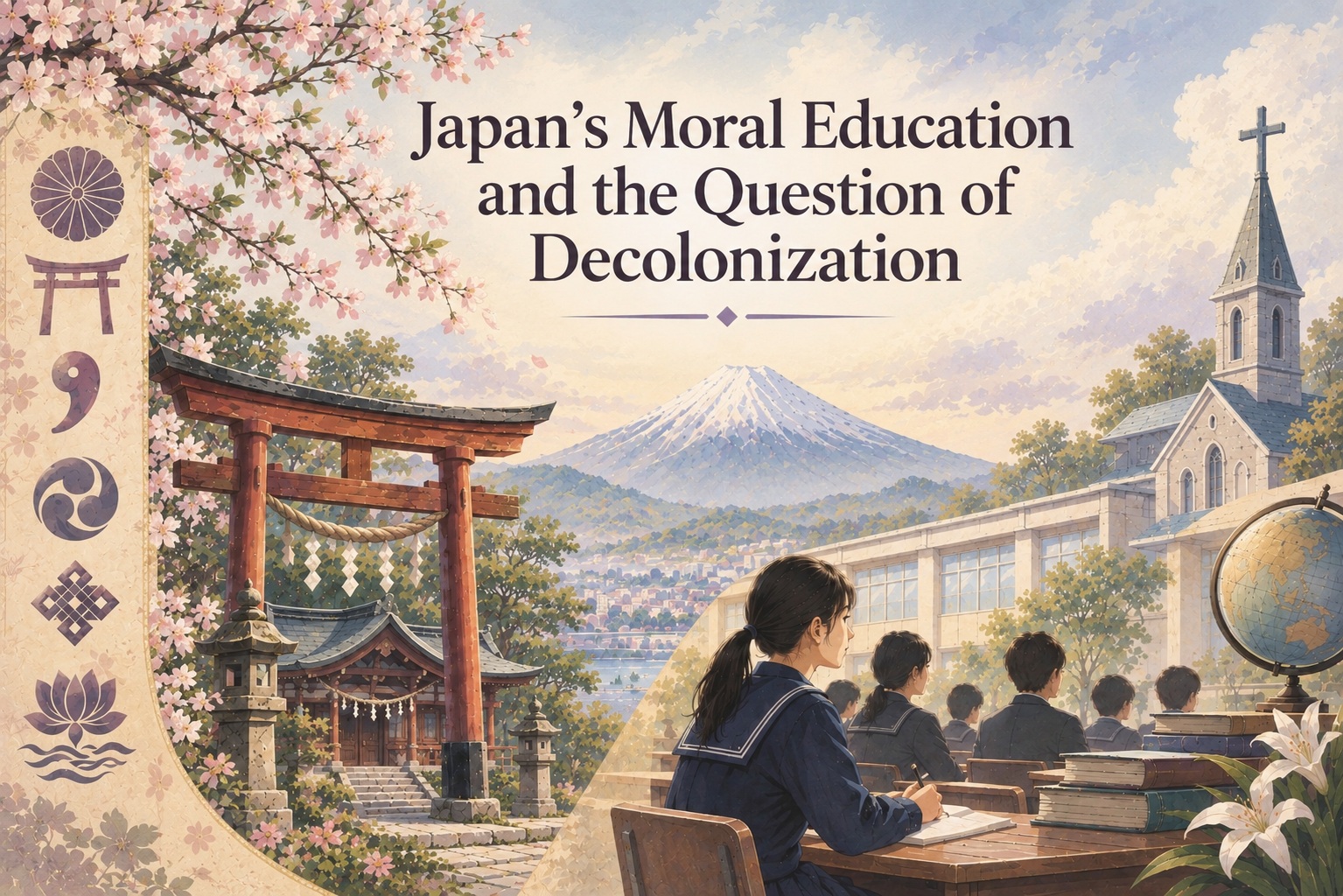
Before World War II, Japanese education was grounded in a moral (dharmic) tradition shaped by Shinto, Confucian ethics, Buddhist thought, filial piety, social obligation, and reverence for the imperial institution. This Shūshin (修身), or moral training, emphasized character, ethical conduct, loyalty, and social responsibility. Following the 1890 Imperial Rescript on Education, these traditions became increasingly integrated into the institutions of the modern Japanese state (Fridell, 1970; Duke, 2009; Piel, 2019). This institutional framework was disrupted by Japan’s surrender in 1945 and the subsequent Allied Occupation, during which General Douglas MacArthur, as Supreme Commander for the Allied Powers (SCAP), directed sweeping reforms of Japanese education, religion, and government (MEXT, n.d.). On December 15, 1945, SCAP issued the Shinto Directive, ending government sponsorship of State Shinto and removing Shinto doctrine, ceremonies, and religious symbols from public schools. On December 31, SCAP suspended shūshin, Japanese history, and geography and ordered the withdrawal and review of related textbooks (MEXT, n.d.). The reforms sought to dismantle State Shinto and its associated moral education while promoting secular, democratic institutions within an Occupation that also viewed Christianity as a potential alternative moral framework (Okazaki, 2010). Measures included abolishing State Shinto, removing the Imperial Rescript on Education from public schools, and, just as in American democracy where the Church and State are supposedly separate, measures were put in place to separate Japanese religious institutions from state authority. Japan’s postwar reforms displaced Shinto moral education. This article examines whether contemporary child-welfare policies signal an emerging decolonization process through which Japan is reclaiming its indigenous moral traditions.
The Occupation weakened State Shinto’s role in public education while creating greater opportunities for Christian influence (Okazaki, 2010). This history raises a question of decolonization: how can Japan reclaim authority over its indigenous, Shinto moral and religious inheritance?
In 2022, Japan’s Ministry of Health, Labour and Welfare instructed child-welfare authorities to apply existing child-abuse protections to cases involving religious belief (MHLW, 2022). The guidance followed concerns raised by children of Unification Church members, including allegations of coercion through religious teachings, threats of hell, and restrictions on personal choices (MHLW, 2022; Otake, 2022). These cases raise a broader question: how can Japan protect children from religious coercion?
This development presents an interesting phenomenon, i.e., the beginning of decolonization of education framed as child welfare in Japan. In 1945, the colonized state intervened to prevent the government from using Shinto religion to shape Japanese children. Today, the state is intervening when religious organizations and/or parents use religious authority to control children. Japan is renegotiating the boundaries established after the Occupation-between religion and coercion, family authority and individual rights, and imported postwar Christian norms and its long-standing indigenous Shinto traditions.
Japan’s history of moral education is not simply a story of moving from Shinto practices to secular Western democracy and back. The Occupation dismantled the institutional role of a dharmic moral-religious tradition and replaced it with a Western-influenced approach to education, individual rights, and religion and government. The Christian influence was not overarching precisely because it could not be formalized as a state religion, nor did a majority flock to the Western religion. Japan is now revisiting some of the policies established during the Occupation. This indeed is an interesting development. How far and how quickly will that process of decolonization go? And what can other colonized countries learn from this?
References
Duke, B. C. (2009). The history of modern Japanese education: Constructing the national school system, 1872–1890. Rutgers University Press.
Fridell, W. M. (1970). Government ethics textbooks in late Meiji Japan. The Journal of Asian Studies, 29(4), 823–833. https://doi.org/10.2307/2943090
Hardacre, H. (1989). Shinto and the state, 1868–1988. Princeton University Press.
Ministry of Education, Culture, Sports, Science and Technology. (n.d.). GHQ directives concerning supervisory policies and educational administration. Government of Japan. https://www.mext.go.jp/b_menu/hakusho/html/others/detail/1317417.htm
Ministry of Health, Labour and Welfare. (2022, December 27). 宗教の信仰等に関係する児童虐待等への対応に関するQ&A [Q&A on responding to child abuse and related matters involving religious faith]. Government of Japan.
O’Brien, S., & Ohkoshi, D. (1996). To dream of dreams: Religious freedom and constitutional politics in postwar Japan. University of Hawaiʻi Press.
Okazaki, M. (2010). Chrysanthemum and Christianity: Education and religion in occupied Japan, 1945–1952. Pacific Historical Review, 79(3), 393–417. https://doi.org/10.1525/phr.2010.79.3.393
Piel, L. H. (2019). The school diary in wartime Japan: Cultivating morale and self-discipline. Modern Asian Studies, 53(4), 1004–1037. https://doi.org/10.1017/S0026749X17000439