
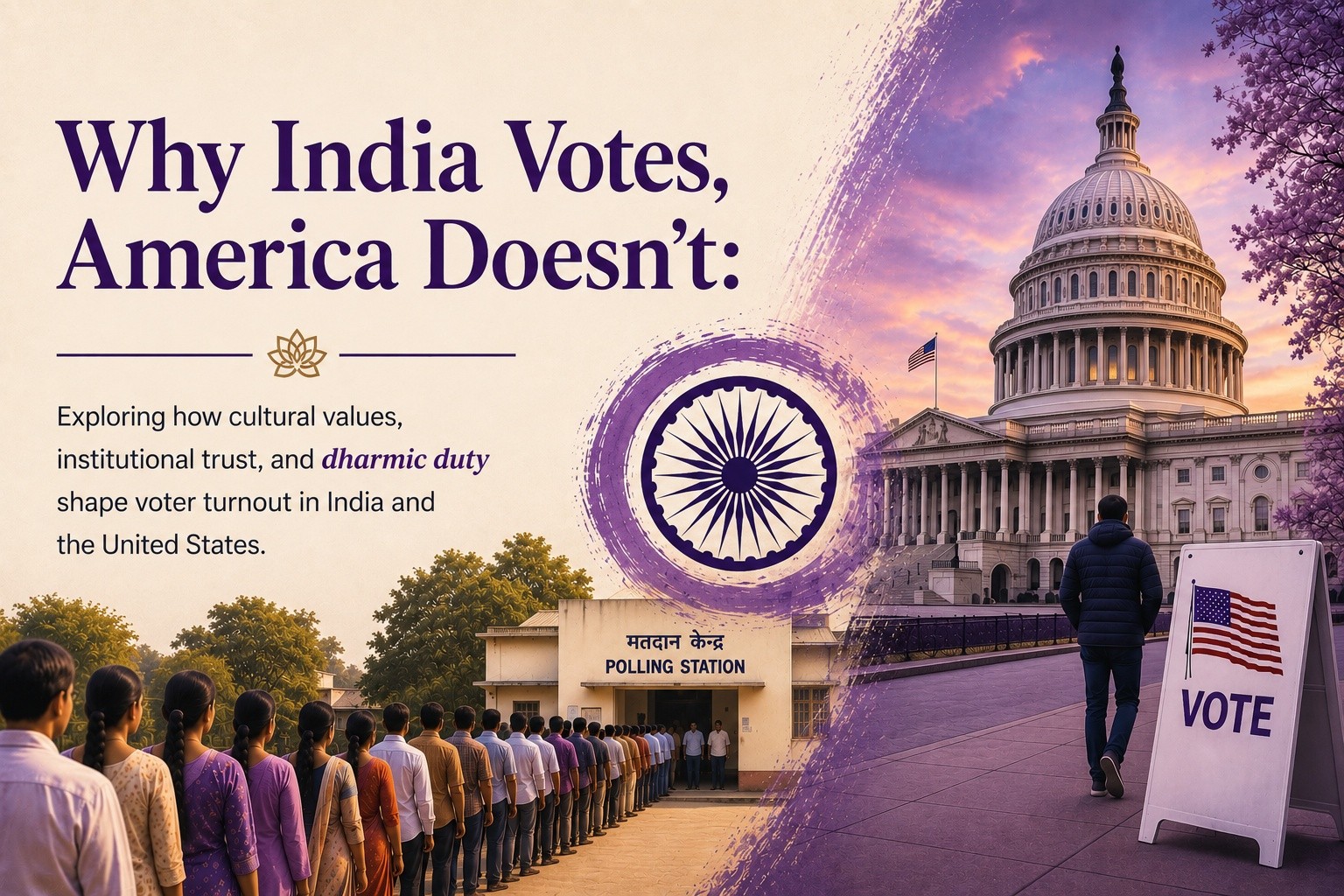
India’s 2024 general election, one of the largest democratic exercises in history, involved more than 642 million voters casting ballots across seven phases (Election Commission of India, 2024). The Election Commission also reported an overall turnout of approximately 65.8%, reflecting sustained mass political engagement despite growing concerns regarding political polarization and institutional trust (Election Commission of India, 2024). State elections have similarly produced record-breaking turnout levels. During the 2026 assembly elections, West Bengal recorded voter turnout exceeding 92%, while Tamil Nadu reported approximately 85% turnout-the highest participation rate in the state since Independence (Election Commission of India, 2026). Assam also experienced strong electoral participation – 85.5% – during the 2026 elections, reinforcing broader patterns of continued civic engagement across India’s regional democracies (The Times of India, 2026).
Voter turnout in India and the United States reflects differences in culture, institutional trust, and mobilization. While India has generally maintained high and even increased voter participation, the U.S. has struggled with lower turnout and growing political apathy (Ahuja & Chhibber, 2012; Dalton, 2017). Political science literature attributes this divergence to electoral accessibility, civic culture, and public confidence in institutions (Putnam, 2000; Verba et al., 1995). I attribute the sustained voter participation in India to duty tied to one’s dharma. India’s sustained high voter turnout reflects a political culture in which voting is perceived not merely as a right, but as a dharmic duty. While caste-based mobilization has historically shaped Indian elections, sustained mass participation suggests the presence of broader civic and cultural motivations beyond identity politics alone.
In India, voting has historically functioned as more than a civic obligation; it has also served as a mechanism of social recognition and political empowerment for marginalized groups. Yadav (1999) argues that the expansion of democratic participation among lower castes and rural voters transformed Indian elections into a highly participatory process. Similarly, Ahuja and Chhibber (2012) found that poorer citizens in India often view voting as essential to securing state responsiveness and access to public goods. While voter participation in India has remained high despite fluctuations in trust in government, the cause is not altogether understood by Western frameworks – people from the subcontinent have an innate understanding that it is their duty, their dharma, to participate in something greater than themselves. Thus, elections are not mere political exercises, but reflections of moral duty, and casting one’s vote and standing in long lines to perform duty is not widely perceived as burdensome.
In modern U.S. elections, roughly one-third of eligible Americans do not vote. At the same time, presidential turnout usually hovers around 60–65% and midterm turnout at 40-50% (McDonald, 2025), revealing a challenge to democratic participation and civic disengagement. Comparable moral frameworks tied to collective civic duty appear less prominent in contemporary American political culture. Institutional barriers and declining trust in government have hindered voter turnout in the United States. Wolfinger and Rosenstone (1980) demonstrated that complicated voter registration systems and socioeconomic inequality depress participation, particularly among lower-income citizens. Putnam (2000) links declining voter turnout to weakening civic engagement and social capital, arguing that Americans have become increasingly disconnected from community institutions and collective public life.
Scholarship has expanded this argument by emphasizing institutional distrust. Brady and Kent (2022) observe that public confidence in major American institutions has “fallen precipitously” over the past fifty years, largely due to polarization and skepticism toward institutional accountability. Pew Research Center surveys (2019) indicate that many Americans believe trust in government has steadily eroded, making collective political action more difficult. Interestingly, distrust in government in the U.S. is not linked to political mobilization. Unlike India, distrust in government in the United States has not translated into higher political mobilization or participation.
Comparative research suggests that democratic participation is closely linked to institutional legitimacy and public trust. Inglehart et al. (2020) argue that many emerging democracies tend to sustain higher levels of institutional trust because voting is still widely viewed as a pathway to political voice and social advancement. Yet an important question remains: if political polarization and distrust continue to grow within India, could voter participation eventually decline in ways that mirror trends in the United States? In such a scenario, civic engagement rooted in collective and dharmic responsibility may weaken as electoral politics becomes increasingly polarized.
These questions remain unresolved. Nevertheless, India’s democracy still beats with a strong sense of collective and dharmic obligation-perhaps helping explain Myron Weiner’s “Indian Paradox”: why India, against many early expectations, has sustained democratic resilience, robust electoral participation, and economic progress in the postcolonial era.
References
Ahuja, A., & Chhibber, P. (2012). Why the poor vote in India: “If I don’t vote, I am dead to the state.” Studies in Comparative International Development, 47(4), 389–410. https://doi.org/10.1007/s12116-012-9119-3
Brady, H. E., & Kent, T. B. (2022). Fifty years of declining confidence and increasing polarization in trust in American institutions. Daedalus, 151(4), 43–66. https://doi.org/10.1162/daed_a_01924
Dalton, R. J. (2017). The participation gap: Social status and political inequality. Oxford University Press.
Election Commission of India. (2024). General elections to Lok Sabha 2024: Voter turnout statistics. https://eci.gov.in
Election Commission of India. (2026, April 23). Tamil Nadu (84.69%) and West Bengal (Phase-I) (91.78%) record highest-ever poll participation since Independence. Press Information Bureau. https://www.pib.gov.in/PressReleasePage.aspx?PRID=2255010
Inglehart, R., Haerpfer, C., Moreno, A., Welzel, C., Kizilova, K., & Diez-Medrano, J. (2020). World Values Survey: Round seven country pooled datafile. World Values Survey Association.
McDonald, M. P. (2025). United States voter turnout. United States Elections Project, University of Florida. https://www.electproject.org/national-1789-present
Pew Research Center. (2019, July 22). Key findings about Americans’ declining trust in government and each other. https://www.pewresearch.org/short-reads/2019/07/22/key-findings-about-americans-declining-trust-in-government-and-each-other/
Putnam, R. D. (2000). Bowling alone: The collapse and revival of American community. Simon & Schuster.
The Times of India. (2026, April 26). Assembly polls: West Bengal turnout hits 93.2%, Tamil Nadu settles at 85.1%. https://timesofindia.indiatimes.com/india/after-recheck-west-bengal-turnout-hits-93-2-tamil-nadu-settles-at-85-1/articleshow/130524800.cms
Verba, S., Schlozman, K. L., & Brady, H. E. (1995). Voice and equality: Civic voluntarism in American politics. Harvard University Press.
Wolfinger, R. E., & Rosenstone, S. J. (1980). Who votes? Yale University Press.
Yadav, Y. (1999). Electoral politics in the time of change: India’s third electoral system, 1989–99. Economic and Political Weekly, 34(34/35), 2393–2399.