
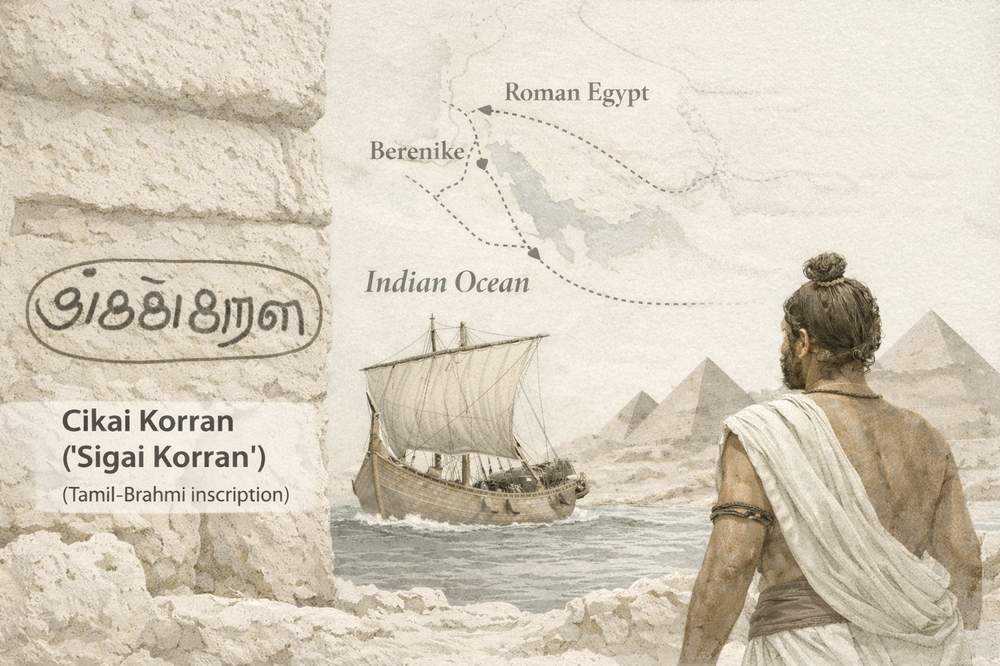
The recent identification of Tamil-Brahmi inscriptions in Egypt’s Valley of the Kings has important implications for understanding early Indian travels and participation in Afro-Eurasian exchange networks. When compared with canonical Tamil-Brahmi inscriptions from cave sites in Tamil Nadu, the epigraphic evidence supports the presence of educated Asian travelers deep in the Egyptian interior during the early Common Era (1st–3rd centuries CE). Tamilakam, as a region corresponds to modern Tamil Nadu, Kerala, southern Karnataka and Andhra Pradesh, as well as northern Sri Lanka. Paleographic analysis suggests that the Egyptian inscriptions are closely related in style and era to Southern Indian Tamil-Brahmi epigraphy.
Introduction
The Indian subcontinent was deeply enmeshed in long-distance networks of trade, religion, and culture. Maritime exchanges between Indian ports and the Red Sea are well documented, though inland mobility has been harder to trace archaeologically (Ray, 2003). The discovery of Tamil-Brahmi script in the Valley of the Kings (a pharaonic burial area) extends this evidence beyond coastal hubs like Berenike and Myos Hormos (Egyptian Red Sea ports important for Indo-Mediterranean trade), showing that Tamil presence in Egypt is expected rather than surprising.
Excavations at Berenike have yielded 1st-century CE black pepper (Piper nigrum), Roman amphorae, beads, and textiles. The Periplus of the Erythraean Sea describes Southern Indian merchants trading with Egyptian ports (Cappers, 2006). Indian beads in East Africa (Horton, 1996), ceramics and inscriptions in Oman and the Gulf (Potts, 1990), and Akkadian references to Meluhha in Mesopotamia (Lawler, 2006) also confirm that India was actively connected to regions across the Indian Ocean. Inscriptions in Sanskrit and Brahmi-derived scripts, Indianized polities like Srivijaya, and Buddhist texts along the Silk Road illustrate both commercial and cultural mobility (Kulke, 1993; Neelis, 2011). Roman coins in Tamil Nadu and Indian ivory in the Mediterranean highlight reciprocal exchange (Sidebotham, 2011).
Taken together, such evidence shows that Indians were active participants in transregional networks centuries before the medieval period (c. 500–1500 CE). The Luxor Tamil-Brahmi inscriptions add a rare epigraphic dimension: physical presence. Alongside Red Sea ports, Gulf material, Southeast Asian inscriptions, and Mesopotamian texts, they reflect a well-established pattern of Tamil mobility in the first millennium CE (Rajan, 2015; Jeyaraj, 2020).
The Egyptian Tamil-Brahmi Inscriptions
Recent surveys in the Valley of the Kings have uncovered around 30 Indian-language inscriptions, including about 20 in Tamil-Brahmi, mostly brief graffiti stating “I was here” and repeatedly mentioning a Tamil trader named Cikai Korran, likely a Brahmin indicated by his shikha (InsightsonIndia, 2026; Times of India, 2025; Falk, 2006; Mahadevan, 2003). Dating from the 1st to 3rd century AD, these inscriptions, alongside evidence of Greek-language trade contracts, demonstrate that Tamil merchants from ancient Tamilakam participated in extensive trade networks connecting ports like Muziris to Egyptian hubs such as Berenike and the Roman Empire (UNESCO; Ray, 2003).
The paleographic shape of the graphemes, including distinctive alphasyllabic vowels and consonant clusters, aligns closely with early historic Tamil-Brahmi inscriptions from Southern India (Mahadevan, 2003; Falk, 2006; Rajan, 2015). Based on morphological comparison and contextual erosion patterns, these inscriptions are securely dated to the 1st–3rd centuries CE, well before the medieval period (c. 500–1500 CE), situating the Luxor texts firmly within early transregional mobility rather than later contact (Falk, 2006; Rajan, 2015).
Paleographic Comparison: Egypt and Tamil Nadu
Tamil-Brahmi, derived from Brahmi, is attested in Southern India as early as the 3rd century BCE and flourished through the early centuries CE (Champakalakshmi, 2010). Linear cave graffiti from sites such as Keeladi and Mangulam display early vowels (Ᾱ/ஆ, I/இ) and consonants (Ḷ/ள, Ñ/ஞ) with angular strokes, mirrored in the Egyptian inscriptions (Natarajan, 2015). Funerary inscriptions from urn burials near Uraiyur show complex conjuncts and marginal ligatures, including names like Korran, paralleling the Luxor texts (Mahadevan, 2003). Distinctive features – such as the extended tail on க (ka) and articulation of ற் (ṟ) – are characteristic of Dravidian phonetic representation and absent in contemporary Mauryan Brahmi, reinforcing a Southern Indian origin (Mahadevan, 2003; Falk, 2006).
Discussion
Unlike imported goods, the inscriptions show that individuals from the Indian subcontinent physically reached the Egyptian interior. The paleography closely matches Southern Indian Tamil-Brahmi, indicating both literacy and familiarity with local writing conventions. Combined with trade evidence from the Levant, Anatolia, and Red Sea ports, these texts reveal that movement from the Indian subcontinent was an integral part of early intercontinental exchange.
Paleographically consistent with Southern Indian Tamil-Brahmi, the Luxor inscriptions strengthen evidence for the presence of individuals from the Indian subcontinent beyond maritime frontiers. Together with archaeological and textual data from the Eastern Mediterranean, they confirm the subcontinent’s role in early globalization, highlighting Tamil participation in Afro-Eurasian networks centuries before the medieval period.
References
Beckmann, S. (2018). Spice Routes and Ancient Trade in the Levant. Journal of Near Eastern Archaeology, 82(3), 45–62.
Champakalakshmi, R. (2010). Trade, Ideology, and Urbanization: South India 300 BCE–1300 CE. Oxford University Press.
Galili, E., Weiss, E., & Porat, N. (2020). Intercontinental exchanges: South Asian spices in Eastern Mediterranean contexts. Antiquity, 94(375), 1120–1135.
InsightsonIndia. (2026, Feb 12). Tamil-Brahmi inscriptions in Egypt’s Valley of the Kings. https://www.insightsonindia.com/2026/02/12/tamil-brahmi-inscriptions-in-egypt
Lawler, A. (2006). Indus civilization gains new perspectives. Science, 312(5772), 1263.
Mahadevan, I. (2003). Early Tamil Epigraphy: From the Earliest Times to the Sixth Century CE. Harvard University Press.
Natarajan, S. (2015). Paleographic study of Tamil-Brahmi in Keeladi and surrounding sites. South Asian Archaeological Review, 12(1), 87–109.
Ray, H. P. (2003). The Archaeology of Seafaring in Ancient South Asia. Cambridge University Press.
Times of India. (2025, Dec 10). Researchers find 2000-year-old Tamil-Brahmi inscriptions on Egyptian tombs. https://timesofindia.indiatimes.com/city/chennai/researchers-find-2000-year-old-tamil-brahmi-inscriptions-on-the-tombs-of-egyptian-kings/amp_articleshow/128222349.cms
UNESCO. (n.d.). Ancient Thebes – Valley of the Kings [World Heritage profile]. UNESCO World Heritage Centre. https://whc.unesco.org/en/list/87/